Sharing the Bounty
Tuesday, August 25, 2026
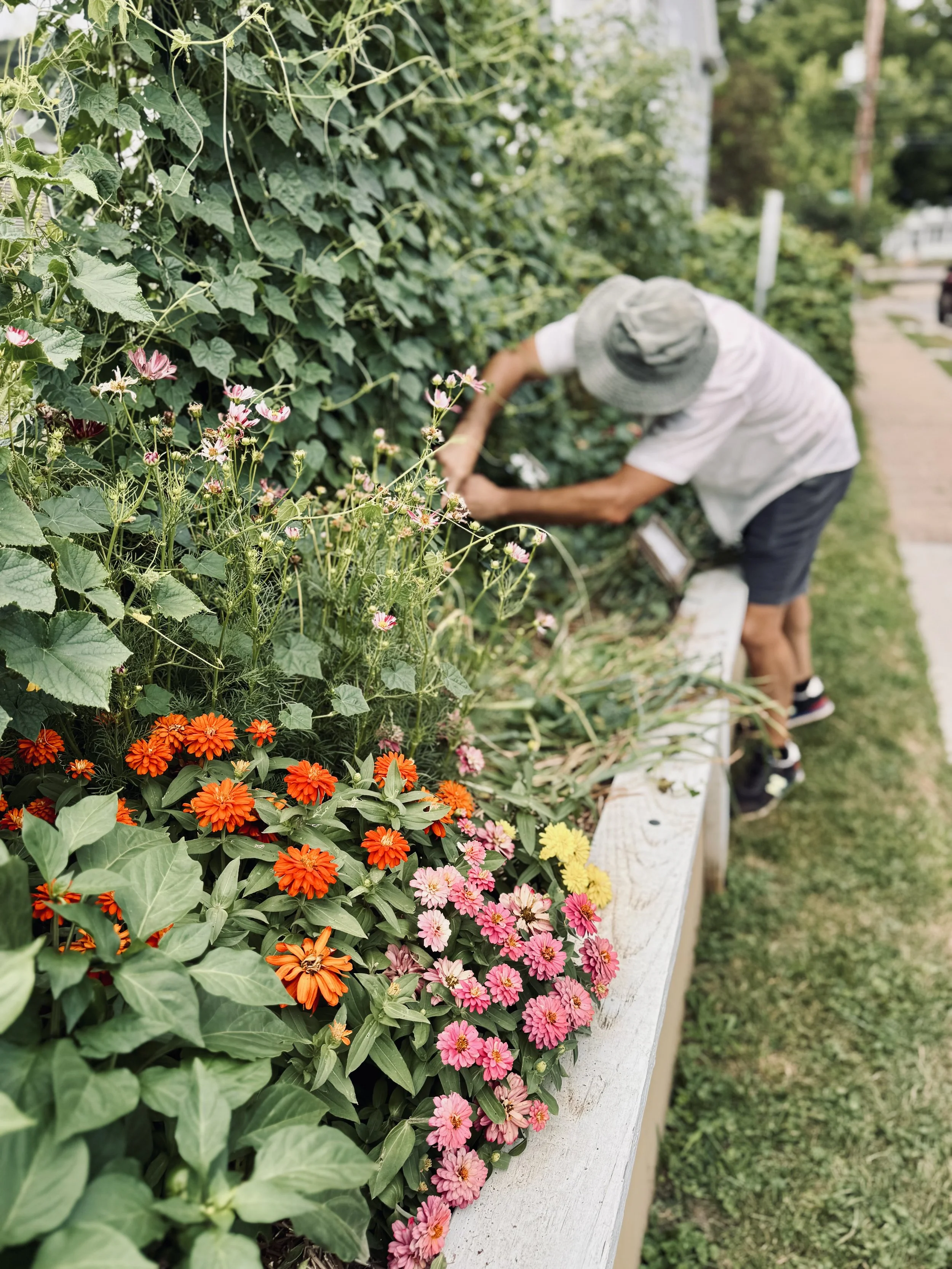
At Convivium we grow three types of gardens – production gardens, demonstration gardens, and a third type that we call Common Beds. These are all grown in yellow raised beds and are peppered throughout the neighborhood close to Convivium. These gardens we plant and tend with the specific purpose of sharing with those who need food.
So if you are walking by, please help yourself to whatever you see growing in these yellow beds! Each bed contains signage that explains what the vegetables are and when and how to harvest them.
This is a gift to our neighbors and to those in need.
Convivium is located in one of Dubuque’s low-income, low-access neighborhoods, sometimes referred to as a food desert – a place where residents have limited access to affordable, healthy food. And often what happens in neighborhoods like this (and we definitely see this in the North End) is that convenience stores and fast-food restaurants crop up. They sell cheap food – cheap in terms of both money and nutrition.
I’ve heard this phenomenon called a “food swamp,” which I think is a pretty apt description. The problem isn't simply that healthy food is hard to find; it’s that highly processed food is everywhere. It’s inexpensive, convenient, heavily marketed and, let's be honest, engineered to taste really, really good.
And we are paying a price for it.
Only about one in ten American adults eats enough fruits and vegetables. At the same time, about six in ten U.S. adults live with at least one chronic disease, and four in ten have two or more. Diet is an important risk factor for many of the diseases that affect us most – including heart disease, stroke, type 2 diabetes and hypertension.
Nearly half of American adults have high blood pressure. More than 38 million Americans have diabetes. These aren't just statistics about some distant population. They are our neighbors, our families, our friends – and, increasingly, ourselves.
For people living in poverty, the problem can be compounded by limited access to healthy food, transportation, time, kitchen equipment and affordable health care. But this isn't exclusively a problem of poverty. Our entire food environment makes it remarkably easy to eat poorly and remarkably difficult to eat well.
It is a huge, complex problem, and I don't have any kind of answer.
But I can offer a tomato.
Or a cucumber. Or some kale. Or a handful of fresh herbs.
We are under no illusion that a yellow raised bed filled with vegetables is going to solve food insecurity or chronic disease. It isn't going to fix our food system. It isn't going to change the economics of poverty or make health care more accessible.
But it can make a difference to the person who walks by and picks a few tomatoes for dinner.
And maybe that's enough.
Because at Convivium, we believe that food is more than something we eat. Food is a way to connect to one another. Sometimes that looks like a free casserole. Sometimes it looks like a cooking class. Sometimes it looks like teaching someone how to grow a vegetable.
And sometimes it looks like a yellow garden bed on a street corner with a sign that says:
Please take what you need.
We are often asked if we are worried about people abusing the Common Beds.
No, we aren't.
Please take all our tomatoes.
That is the point.
Yours convivially,