Compost: Turning Waste into Life
Tuesday, August 18, 2026
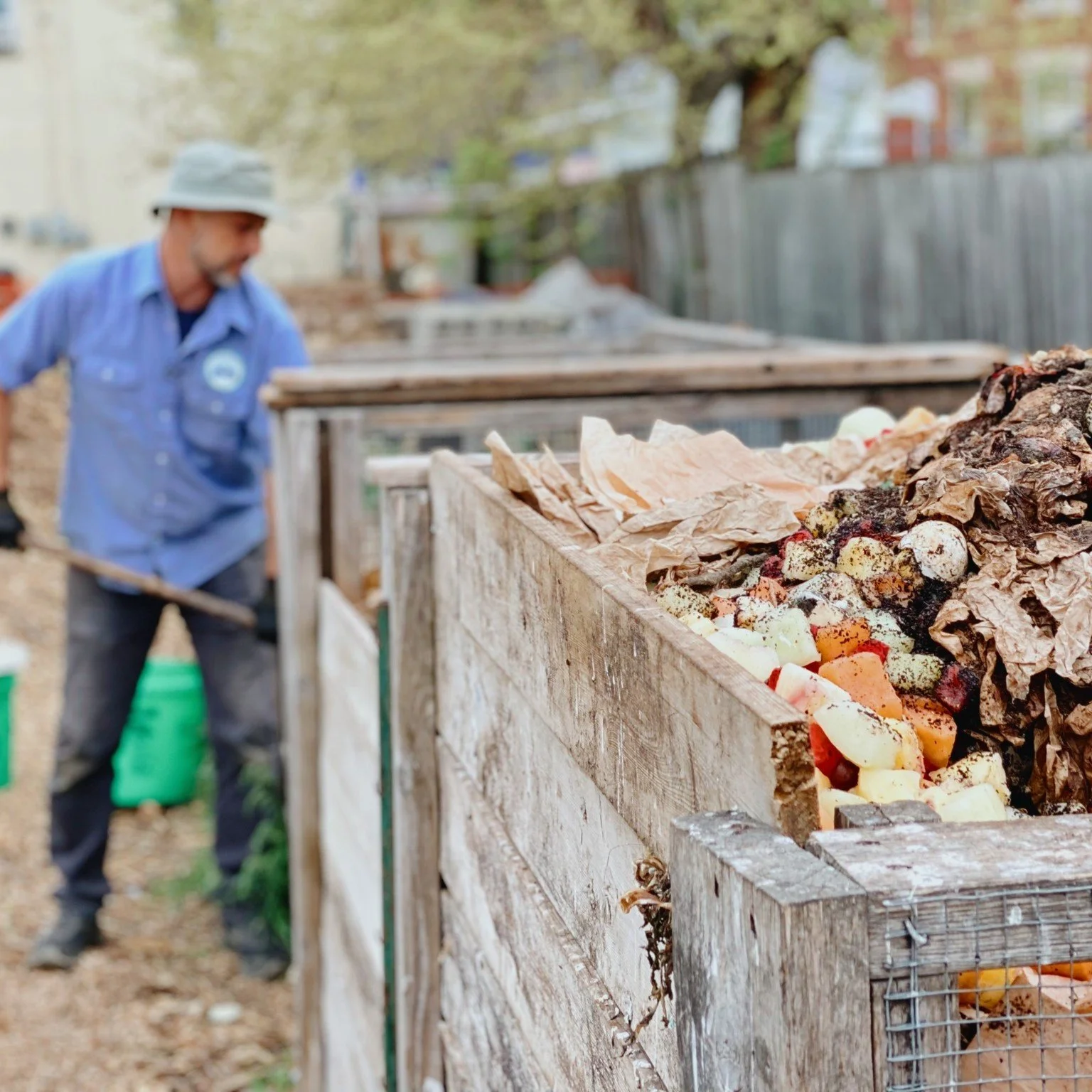
Each year, I’m amazed by the health, strength and bounty of our gardens at Convivium (thank you AJ!). And we’re asked all the time: What do you do to make everything grow so well?
The answer is simple: Compost.
(Well, compost and years of intentionally building healthy soil — but we’ll save that story for another blog post!)
Every year at Convivium, we compost more than 6,000 pounds of food scraps and paper waste from our restaurant. That means more than 6,000 pounds of material that would otherwise go to the landfill is instead returned to the earth. And that’s where the beauty lies.
When we compost, we’re not just getting rid of garbage. We’re recycling the nutrients contained in that waste and putting them back to work. Every apple core, coffee ground, vegetable trimming and piece of uncoated paper that goes into our compost eventually becomes part of the soil that helps us grow more food.
It’s a closed loop:
Food → scraps → compost → healthy soil → more food.
At Convivium, our wheel of programming centers around a simple idea: We use food to foster connection to ourselves, our communities and the environment. Composting is one of the most tangible ways we live out that idea. It reminds us that what we think of as “waste” is often just a resource that has reached the end of one part of its journey.
As Wendell Berry — farmer, poet, essayist and one of America’s most influential writers on agriculture and our relationship with the land — wrote in The Unsettling of America: Culture & Agriculture:
“The soil is the great connector of lives, the source and destination of all. It is the healer and restorer and resurrector, by which disease passes into health, age into youth, death into life. Without proper care for it, we can have no community, because without proper care for it, we can have no life.”
That’s a pretty profound description of composting. There is a whole world living in your compost.
We often host students from Dubuque’s alternative high school, and one of the first things we do is give them a tour of our campus, including our compost operation. Our farm manager, AJ, will reach into the compost and pull out a handful of rich, dark humus. Then he tells the students something that usually gets their attention:
That handful of compost contains more bacteria than there are people on the earth.
Imagine that. That microscopic world is part of the magic that makes our gardens grow.
Composting simply helps us harness a natural process. Decomposition is going to happen whether we participate in it or not. Composting creates the conditions — the right balance of organic material, moisture, oxygen and time — that allow that process to happen efficiently and produce a nutrient-rich soil amendment we can return to our gardens.
Why compost?
There are lots of reasons to compost, but three stand out:
1. It reduces waste.
A significant portion of what we throw away is organic material — food scraps, yard waste and other materials that could be composted. When those materials go to a landfill, their nutrients are lost to us. Composting keeps them in circulation.
2. It builds healthy soil.
Compost adds organic matter and nutrients to the soil, improves its structure and helps the soil retain moisture. Healthy soil is the foundation for healthy plants — and healthy plants are the foundation for a productive garden.
3. It keeps nutrients in the cycle of life.
The atoms and molecules that make up our food don’t disappear when we eat it. Composting helps keep those building blocks moving through the natural cycle rather than treating them as garbage.
And there’s another important environmental benefit: when organic material breaks down without enough oxygen in a landfill, it can produce methane, a powerful greenhouse gas. Keeping food scraps out of landfills and returning them to the soil is a simple way to reduce that impact.
Composting at home is easier than you think. I’ve been composting at home for years, and I’ve tried just about every fancy countertop container with carbon filters and special features. You know what works just as well? A plastic gallon ice cream bucket with a lid. Once composting becomes part of your routine, it’s surprising how quickly it becomes second nature. In fact, after a while, it feels strange to throw a banana peel or coffee grounds into the garbage.
A basic compost pile needs a balance of “greens” and “browns.” Greens provide nitrogen: food scraps, grass clippings, egg shells, weeds and farm animal manure. Browns provide carbon: leaves, straw, wood chips, sawdust, dead plants, coffee and tea. The key is creating the right balance and giving your compost enough air, moisture and time to do its work. And yes, you may occasionally encounter a bug or a curious rodent. That’s part of working with nature. It doesn’t have to be complicated or intimidating.
Convivium’s Composting System
Because we generate so much compostable material at Convivium, we use a four-bin system.
We’re always adding new material to Bin 1 and harvesting finished compost from Bin 4. As the compost progresses through the process, we move it from one bin to the next, turning it along the way. This aerates the compost and introduces the oxygen that helps our microorganisms do their work.
Eventually, what started as food scraps and paper becomes rich, dark compost that goes right back into our gardens.
Waste becomes soil. Soil grows food. And the cycle begins again.
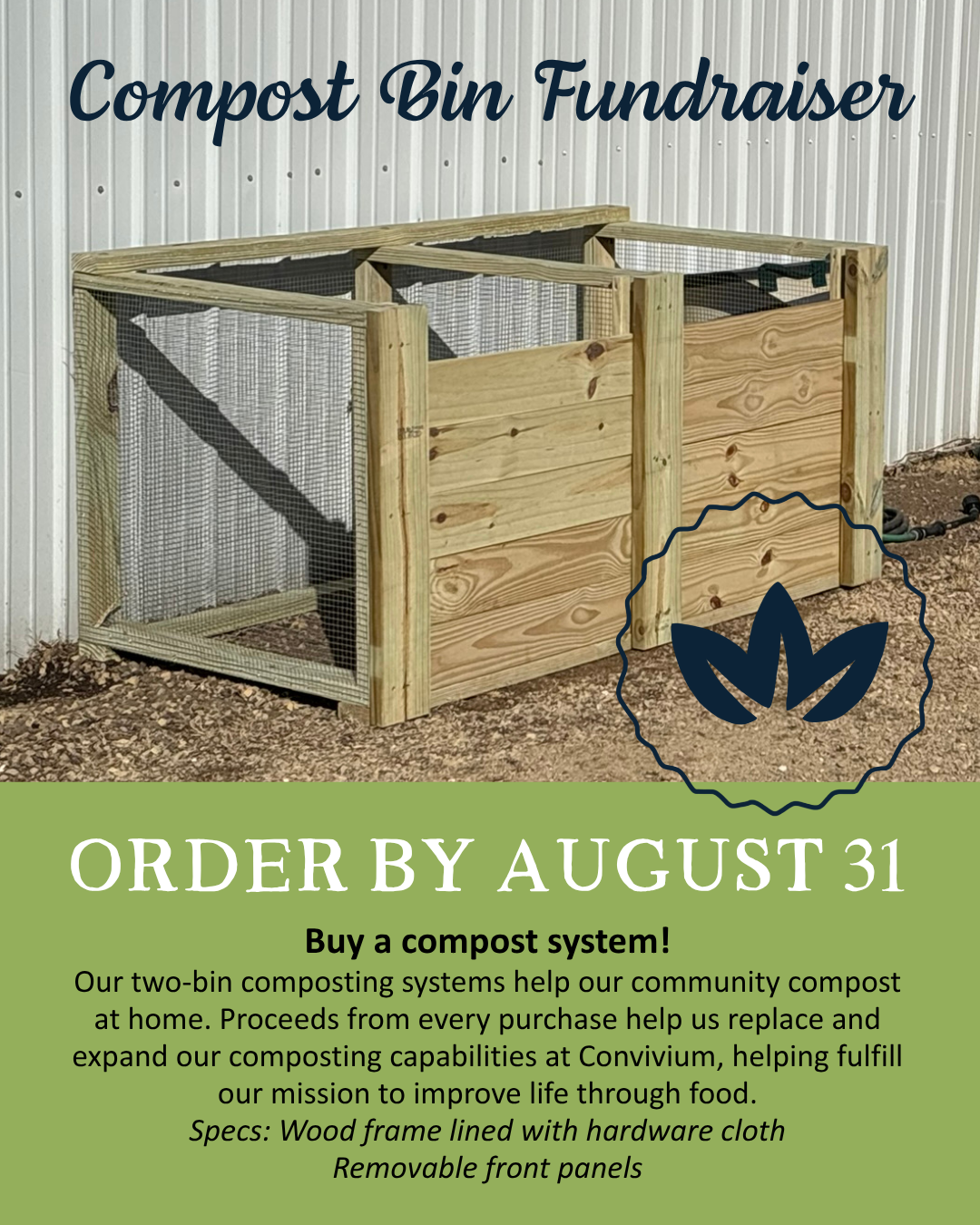
We’ve developed a simpler two-bin version of our system for home gardeners, and now we’re making them available as a fundraiser for Convivium.
Bring the cycle home
Our Convivium compost bins are $250 and measure approximately 6 feet wide × 3 feet high × 3 feet deep. They’re designed to make it easy to maintain an active composting system at home — and when you purchase one, you’re doing two good things at once:
You’re keeping your food scraps out of the landfill and building healthier soil at home, while helping support the ongoing maintenance of Convivium’s gardens and composting operation.
Your purchase helps us continue growing food, teaching people and building a more sustainable community right here at Convivium.
Ready to start composting? Get your handbuilt Convivium compost bin here or call 563-557-2900 to pay with cash/check.
And while our Composting 101 class has already taken place for the year, we do have several free learning opportunities scheduled, centered around growing (with Farm Manager, AJ). Your RSVP is not required but appreciated.
Wednesday, September 16: Cover Crops for Vegetable Gardens Lunch & Learn
Wednesday, October 21: Garden Philosophies Lunch & Learn
Wednesday, November 18: Potted Exoctics Lunch & Learn
Wednesday, December 16: Seed Catalogs Lunch & Learn
Yours convivially,