What the Bees Know
Wednesday, September 3, 2026
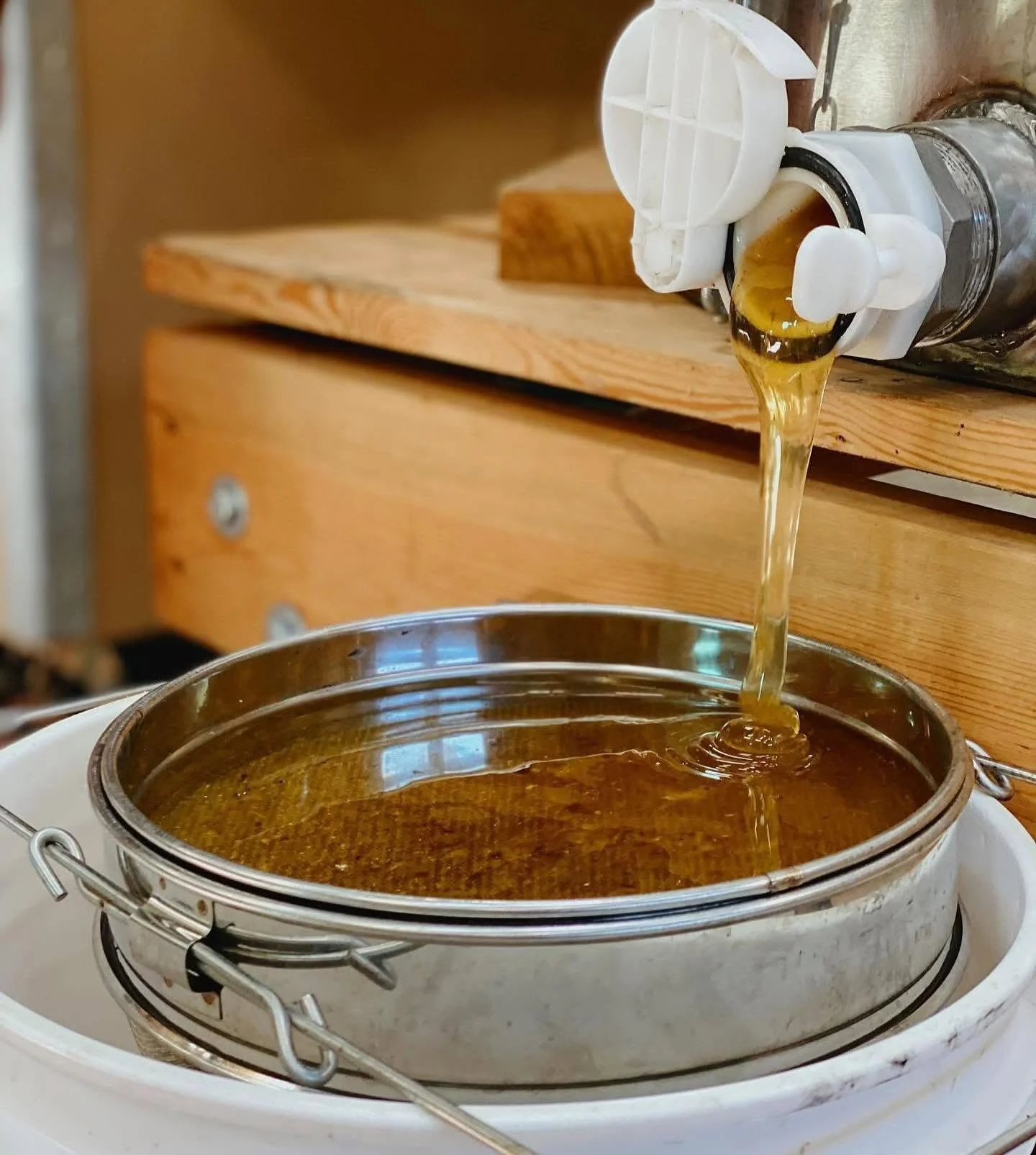
This past week AJ finished harvesting our honey – 218 pounds this year.
The process involves pulling full, “capped” frames of honey from our hives and then removing the thin layer of wax that seals each cell full of honey so that we can extract it using a centrifuge. We do this with a hot knife, carefully trying to preserve as much of the honeycomb as possible to make it easier for the bees the next season.
That honeycomb is precious. Making beeswax is a resource-intensive process for bees. They must consume roughly 10 pounds of honey to produce the energy needed to make one pound of wax. So whenever we can preserve the existing comb, we do. It means the bees don't have to spend that precious energy rebuilding what they've already built.
We also save that thin layer of wax, along with the honey drippings that come with it, in an effort to use every bit of the precious resource the bees have provided for us. We clean and render the wax and use it to make lip balm that we sell in our gift shop. We use the rinsed honey water to make mead, or honey wine.
We harvest honey in July and August, leaving the bees plenty of time to replenish their stores before winter, when freezing temperatures arrive and there are no longer nectar sources available to them.
Because here is the thing about honey: we eat it because it is sweet and delicious. Bees make it because they need it to survive.
Honey provides quick energy and warmth throughout the winter months. It is one of two foods that bees make for themselves. The other is a protein-rich food called bee bread. It is less palatable to humans, so we don't hear about it quite as often, but it is fascinating: fermented pollen mixed with nectar, honey and bee saliva. It provides the protein bees need for growth and development.
In other words, the entire existence of the hive revolves around food. (I can relate!)
We have five hives, or colonies, in our apiary. That number fluctuates from year to year as we sometimes lose hives over the winter and sometimes split healthy hives during the summer. Each hive can contain around 80,000 bees, and every one of those bees plays a role in maintaining the life of the colony.
There are three types of bees in a hive: the queen, who can lay up to 2,000 eggs a day; drones, whose primary role is to mate with a queen; and worker bees, who are all female and perform the enormous variety of tasks required to keep the colony alive.
And the worker bees are remarkable.
Their lives are a progression of jobs, largely dictated by their biology and the needs of the colony.
Their first job is cleaning their own cell. The queen will only lay another egg in an immaculate cell. During this stage, a worker may also become an “undertaker,” removing dead bees from the hive.
As her glands develop, she becomes a nurse bee, feeding developing larvae. A healthy larva is fed approximately every 43 seconds during its development.
Then she may become a queen attendant, feeding and grooming the queen and helping distribute her pheromones throughout the hive.
As she develops further, she becomes a wax mason, producing wax and propolis—the bees' version of caulk—to build honeycomb, fill cracks and cap cells.
Then she may become a house bee, maintaining the hive and receiving pollen and nectar from returning foragers. She processes the pollen, stores it, and turns nectar into honey.
Around days 18 to 21, her venom and defensive abilities are at their peak, and she may become a guard bee, protecting the colony from invaders.
And finally, she becomes a forager.
For the remainder of her short life—about five weeks—she will fly as far as three to five miles from the hive, collecting nectar, pollen, plant saps, resins and water and bringing those resources home.
I find this endlessly fascinating.
Not because bees have figured out some perfect little society that humans should simply imitate. Their world is very different from ours.
But because their survival depends completely on their interdependence.
No single bee can do what a colony needs.
The forager cannot turn nectar into honey without the house bees. The nurse bee cannot care for larvae without the food brought in by the foragers. The wax mason cannot build without the resources gathered by others. And none of them can thrive if the hive isn't healthy enough to support the work.
The work changes as the needs of the community change.
And perhaps most importantly, the colony doesn't exist simply to make something for someone else. The work they do creates the conditions that allow the whole community to survive and thrive.
I think about that a lot at Convivium.
We talk about our mission in four simple words: Improve Life Through Food.
It is easy to think about food as the end product—a casserole, a meal in our restaurant, vegetables from the garden, a cooking class, a jar of honey.
But food is rarely just food. Food requires a community.
It takes the person who plants the seed, the person who tends the garden, the person who harvests the vegetables, the cook who knows what to do with them, the person who washes the dishes, the volunteer who delivers a casserole, the teacher who shares a skill, the donor who makes a program possible, and the neighbor who walks through our doors.
Each contribution makes the next one possible.
And when all of those contributions come together, something much bigger than any individual effort is created.
That is what I think the bees might teach us about community: we don't have to do everything. We just have to understand that what we do matters to the whole.
And like the bees, we are at our best when we recognize that the abundance we create together is something we could never create alone.
Yours convivially,