When Plan “A” Doesnt Work
Tuesday, September 22, 2026
For many years before my work at Convivium, I was a journalist and magazine editor. One of the things I enjoyed most about that job was its cyclical nature. So often in our work lives, there is no distinct beginning or ending to things. We just work, work, work. But with a magazine, there are distinct stages and, ultimately, a finished product every month: planning, interviewing, writing, design, copyediting, proofreading and finally publication.
Not only did we have a finished product every month, but we also had the opportunity to improve the process and the product every month. I did this for almost 15 years, and during that time I developed an internal approach to virtually everything I do: Mistakes and challenges are opportunities to learn and improve.
You might have heard me repeat a little catchphrase that I feel like I say all the time to the team here at Convivium: “If Plan A doesn’t work, we have the whole rest of the alphabet—so let’s figure this out.”
That approach has been particularly helpful in creating something as unique as Convivium. There was no blueprint for what we were doing here. We went against conventional wisdom when we invested in the neighborhood and property where Convivium is located. We built a business around connection, community, food and generosity—not exactly the norm in a profit-driven environment.
And it has yielded some pretty amazing results: a profitable business, yes, but also connection, community, people feeling seen and valued, good food, a network of neighborhood gardens producing two tons of produce each year, and so much more.
It hasn't come without mistakes, missteps and many, many challenges. But we keep working our way through the alphabet, figuring out what works and what doesn't.
Perhaps not coincidentally, this is also the nature of gardening itself.
Gardening is cyclical. Many factors are outside our control. And every growing season gives us another opportunity to learn and try something a little differently.
As the 2026 growing season winds down, I sat down with AJ, our farm manager, to reflect on the season. I think it is important to talk about some of the things that didn't go exactly as planned—not because we did something wrong, but because even though we do this professionally, we don't have all the answers. Things don't always work. We make mistakes. We make errors in judgment. We try something new and sometimes it doesn't work as well as we'd hoped.
And then we try again.
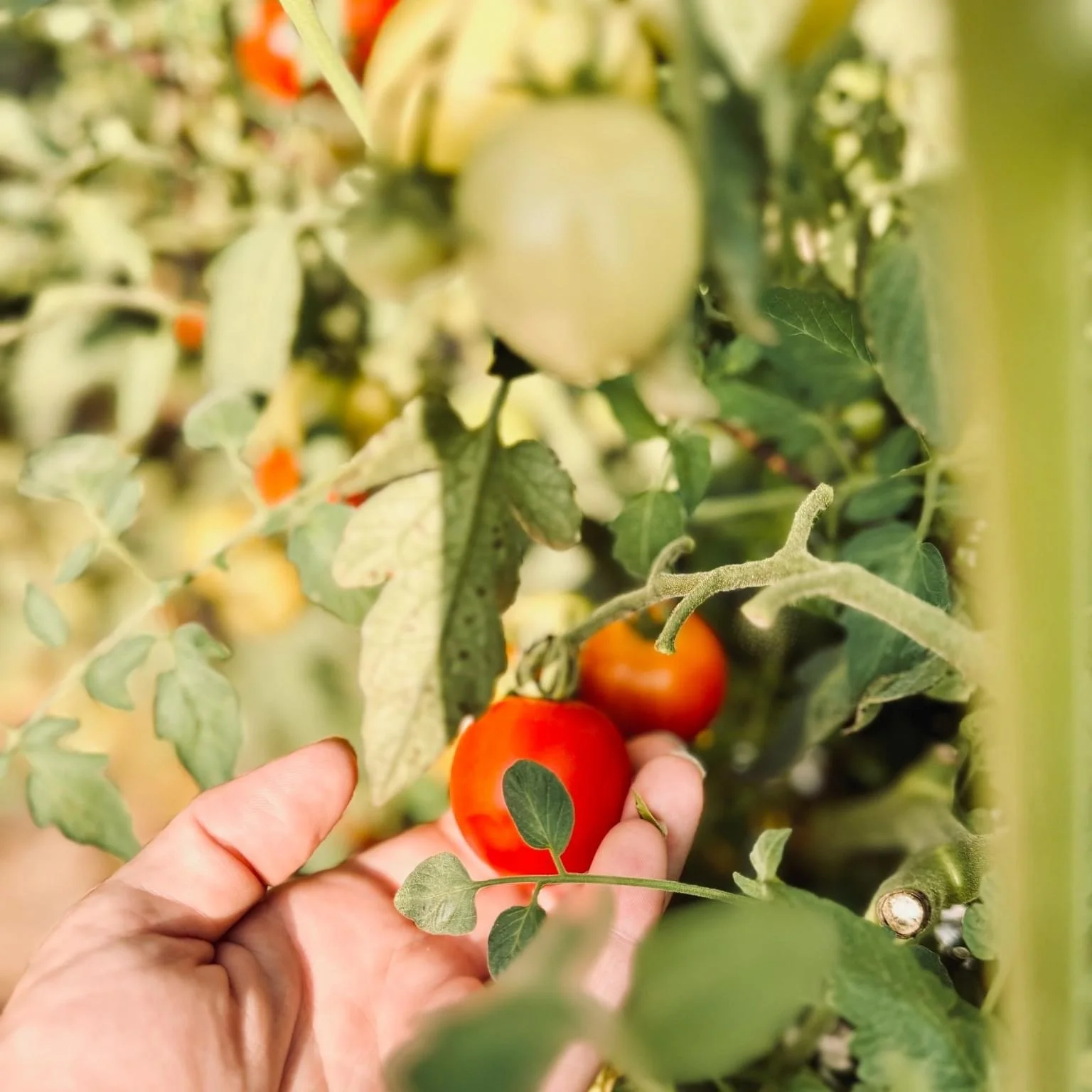
Last year, we trialed some dwarf tomatoes. These are indeterminate tomatoes, meaning they produce fruit throughout the season, but they grow on compact plants that don't require pruning or extensive staking. They performed so well in our trial last year that we planted many more this year—and had equally amazing results. These will definitely stay on Convivium's permanent grow list.
In years past, we've also had problems with disease spreading among our cucumber plants. We might prune one plant that has an issue, only to unknowingly spread the disease to other plants when we use the same pruning tools.
So this year, we planted our cucumbers in several different gardens, quite far from one another. The result? Our biggest cucumber harvest on record.
We also grow a significant quantity of paste tomatoes that we use in our Bloody Mary mix and tomato jam. This year, we added an interwoven course of twine—kind of like a giant cat's cradle—to our typical strands between the stakes. That small change prevented about 10 percent of our tomato crop from being lost to rot.
That's an extra 150 pounds of tomatoes.
Three small examples, but each one represents the same basic process: try something, observe what happens, learn from it, and change what you do the next time.
I think there is a lot to be said for adopting this approach to life more broadly.
So often, we can become paralyzed by planning, analysis and the desire to choose the right approach. We want to know that something will work before we're willing to begin. But sometimes the only way to know is to try.
You're probably not going to get it right on the first try. And that's okay.
Start anyway. Pay attention. Learn. Adjust.
And remember: If Plan A doesn't work, you have the whole rest of the alphabet.
Yours convivially,